
Rabin Medical Center Saves Breast Cancer Patients with New Mammography Techniques
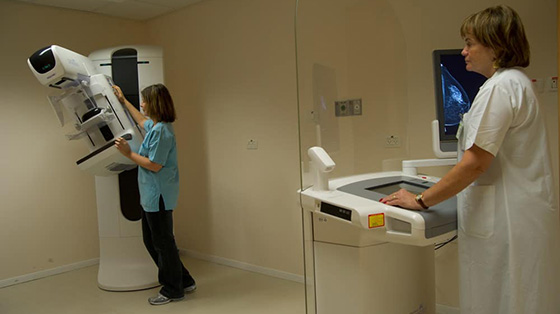
A researcher at Zebra Medical Vision has created a new mammography algorithm that uses machine and deep learning to diagnose breast cancer (BC), with results that the company claims are superior to those achieved using current methods. Zebra’s mammography algorithm, developed with the aid of thousands of patient studies, aims to optimize BC screening by reducing both false positive results and false negative results. According to the company, this will lead to fewer unnecessary tests (a cost-savings measure) and lower stress for patients.
Doctors advise women over age 45 to be screened for BC every two years. Of these screenings, about 10 percent will be sent for specialized evaluation due to suspicious findings. But most women who undergo biopsies are found not to have cancer, while among the roughly 5 in every 1,000 who do develop breast cancer, one case of cancer is usually missed. In aiming for more accurate results, the Zebra algorithm may both protect women from unnecessary and possibly invasive tests, or from having a cancer that is left undetected.
“As a mammographer, I am cognizant of the vast variations in which breast cancer can manifest on a mammogram. Some of the most challenging cancer diagnoses are ones where the visual cues are not distinct lesions but rather regional asymmetry or architectural distortion in the breast tissue,” said Dr. Maya Cohen, director of the imaging institute at Rabin Medical Center. “I welcome Zebra Medical Vision’s algorithm that is a new generation of mammography analysis, which can help us in the mission of finding even the most subtle cancers as early as possible.” (Article from breast-cancernews.com: October 31, 2016)
Related Articles
Male fetuses are more trouble
Judy Siegel-Itzkovich, THE JERUSALEM POST
It isn't an "old wives' tale" that carrying a male fetus is more "troublesome" than carrying a female fetus, according to research encompassing over 66,000 women who gave birth at the Rabin Medical Center (RMC) in Petah Tikva between 1995 and 2006.
A Gift Inaugurating the David Baruch Day Care Floor
On the evening of May 7th, 2006, David Baruch from Fort Lee,
New Jersey, accompanied by his three children Assaf, Sharon
and Karen, officially inaugurated the David Baruch Day Care
Floor at the Davidoff Cancer Center.